
Construction: Chryso and Ecocem combine expertise to accelerate low-carbon concrete development

Reducing the carbon footprint of cement creates significant challenges when it comes to concrete durability and application.
At BATIMAT 2026, Chryso and Ecocem are unveiling a new solution that brings together their complementary expertise: Ecocem ACT low-carbon cement technology combined with EnviroMix® 3150 ACT, a new EnviroMix® admixture solution co-developed by Chryso and Ecocem. The collaboration aims to simplify the formulation, production and placement of high-performance, low-carbon concrete, helping to accelerate its adoption on a wider scale.
Less clinker, performance-driven concrete: A formulation challenge
Reducing the amount of clinker in cement is recognised as one of the most effective approaches to decarbonising cement production. ACT technology, developed by Ecocem, directly addresses this challenge. However, achieving optimum durability in concrete produced using ACT technology also requires admixture solutions specifically adapted to its characteristics.
This is where Chryso’s expertise in construction chemistry plays an important role.
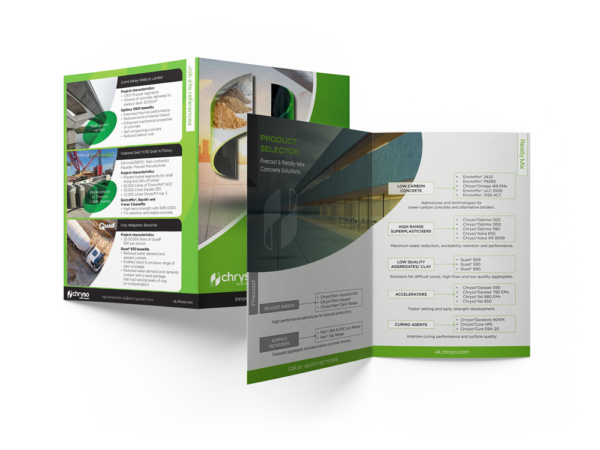
Working closely with Ecocem, Chryso’s R&D teams have developed a new EnviroMix® superplasticizer specifically formulated for use with Ecocem ACT cement. The EnviroMix® range, developed for low-carbon concrete, has grown significantly in recent years to support the rapid evolution of cement technologies. EnviroMix® 3150 ACT represents the latest development within this journey.

From cement innovation to concrete innovation
The collaboration between Chryso and Ecocem brings together two complementary innovations. Ecocem ACT is a low-carbon cement technology capable of reducing cement carbon emissions by up to 70%. Chryso contributes its admixture expertise, adapting to the specific chemistry of this new binder while maintaining the essential properties needed for concrete production and placement.
The work has already led to two patent applications, highlighting the innovative nature of the solution jointly developed by the two companies.

EnviroMix® 3150 ACT: Performance tailored to the requirements of low-carbon concrete
When used in combination with Ecocem ACT cement, EnviroMix® 3150 ACT enables concrete mix designs to achieve a carbon footprint reduction of more than 50%, corresponding to GWR5 classification and beyond.
The resulting highly durable concrete provides high flowability and low viscosity, including at low water-to-cement ratios. It also offers robustness against variations in water content and provides more than 90 minutes of workability retention, which can be extended further without segregation.
A technology already proven on construction sites in the United Kingdom
Ecocem ACT technology is already being used in the UK as part of the refurbishment of the former John Lewis headquarters in London, where almost 1,300 m³ of low-carbon concrete will have been poured by the end of the year.
For the project, C20/25 and C30/37 concrete mixes incorporating Ecocem ACT have been developed. The use of EnviroMix® 3150 ACT delivered 90-minute workability retention alongside excellent pumpability. This application provides valuable feedback from real construction-site conditions and represents an important step in the continued development of this new generation of low-carbon concrete.
The collaboration around Ecocem ACT and EnviroMix® 3150 ACT also creates opportunities for further development, with additional areas of cooperation already being explored to support the continued advancement of low-carbon cements and concretes.
About Ecocem
Ecocem is a pioneer in high-performance technologies designed to help reduce CO₂ emissions across the cement and construction sectors by 50% by 2030 and support the transition towards a more sustainable future.
Its Ecocem ACT low-carbon cement technology can reduce the carbon footprint associated with traditional cement manufacturing by up to 70%. For 25 years, Ecocem has developed, manufactured and supplied low-carbon cements and construction solutions across European markets.
The company has production facilities in France, the Netherlands and Ireland, with an annual production capacity of more than 2 million tonnes. Its solutions have been used on major projects including the Grand Paris Express, the Paris 2024 Athletes’ Village, Dublin’s Aviva Stadium and the UK’s HS2 high-speed rail project, contributing to a cumulative reduction of 18 million tonnes of CO₂.
Its investors include Saint-Gobain, Breakthrough Energy Ventures and ArcelorMittal.
In June 2026, Ecocem France, alongside Bouygues Construction, CB Green and POINT.P, launched the ABCD Alliance (Action Béton & Ciment Durables) to accelerate the decarbonization of the construction sector.